
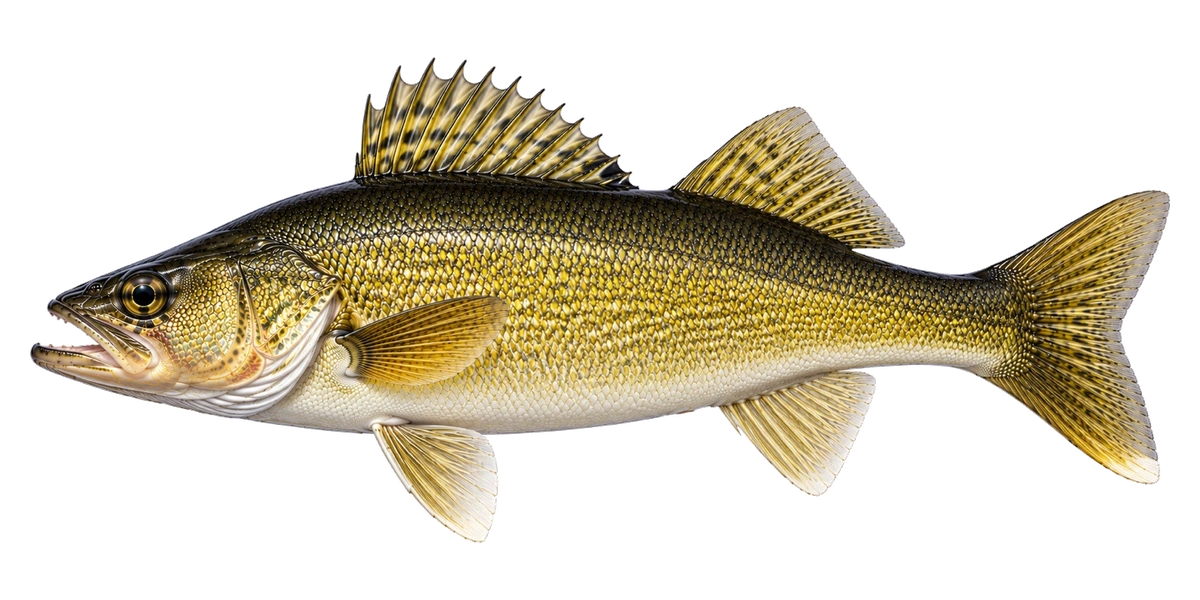
Walleye Fishing at Lake Lanier
Sander vitreusPercidae · Cool-water piscivorous sport fish
Walleye are low-light predators built to hunt fish around rock, points, breaks, current and cool-water habitat. Their sensitive eyes give them an advantage in dim conditions, but successful fishing still comes down to finding usable water and the forage inside it.
Start with the clues that concentrate fish
Look here
Start with habitat that combines low-light periods, cool-water depth zones, and rocky points and breaks. Exact depth and location remain waterbody-specific.
Follow the food
Visual piscivore specialized for efficient hunting in low-light conditions. Match the food actually present in the waterbody and season you are fishing.
How to fish for them
Use jigs and live-bait rigs where legal to work bottom transitions, current and fish marked near structure.
Troll baitfish-profile crankbaits to cover water and intersect roaming fish.
Use vertical spoons or jigs when sonar shows Walleye holding away from the bank or bottom.
Slow bottom-oriented presentations can stay in the strike zone when fish are less willing to chase.
Low-light periods becomes more useful when it overlaps with food, season, and usable habitat.
Usable habitat depends on the combination of temperature, oxygen, season, and food rather than temperature alone.
Rock and coarse substrate can create feeding edges, current breaks, cover, or spawning habitat.
Spring tributary or shoreline spawning movement becomes more useful when it overlaps with food, season, and usable habitat.
Concentrated food can pull Walleye into a much smaller part of otherwise similar water.
Fast facts worth remembering
- Scientific name
- Sander vitreus
- Family
- Percidae
- Feeding style
- visual piscivore specialized for efficient hunting in low-light conditions
- Low-light advantage
- Reflective eye structure improves dim-light sensitivity
- Spawning style
- Broadcast spawner with no nest guarding
Facts that change how you think on the water
The glowing eye is a hunting tool
Walleye eyes contain a reflective layer that improves sensitivity in dim light and produces the characteristic glassy or silvery appearance.
Those teeth are built for fish
Adult Walleye have a large mouth with prominent canine teeth and are strongly piscivorous, commonly eating perch, shad, minnows and other available forage fish.
Spring sends them toward rock and current
Walleye often move toward tributaries, current and rocky or gravel shorelines during spring spawning. Activity frequently increases under low light and after dark.
They scatter eggs and leave
Walleye are broadcast spawners. Fisheries literature describes eggs released over suitable substrate with no parental guarding after spawning.
A seasonal behavior, not a magic temperature
Walleye spawn in spring, often moving toward tributaries, current and rocky or gravel shoreline habitat. Eggs are broadcast over suitable substrate and receive no parental nest guarding.
Fishing use: Spring movement can make river corridors and coarse shoreline substrate disproportionately important compared with summer habitat.
Keep in mind: Use spawning information as a seasonal clue, not as a universal feeding switch.
Three facts that stick
A reflective retinal layer creates the glassy look and boosts sensitivity in dim conditions.
Walleye commonly use low-light and nighttime periods during spring spawning activity over rock, gravel and other suitable substrate.
Unlike black bass, walleye broadcast eggs and leave the developing offspring without parental nest defense.
Low light helps. Food still decides.
Walleye eyes are built for dim conditions, but low light alone does not create a bite. Find the baitfish, then use rock, current and depth to narrow the search.