
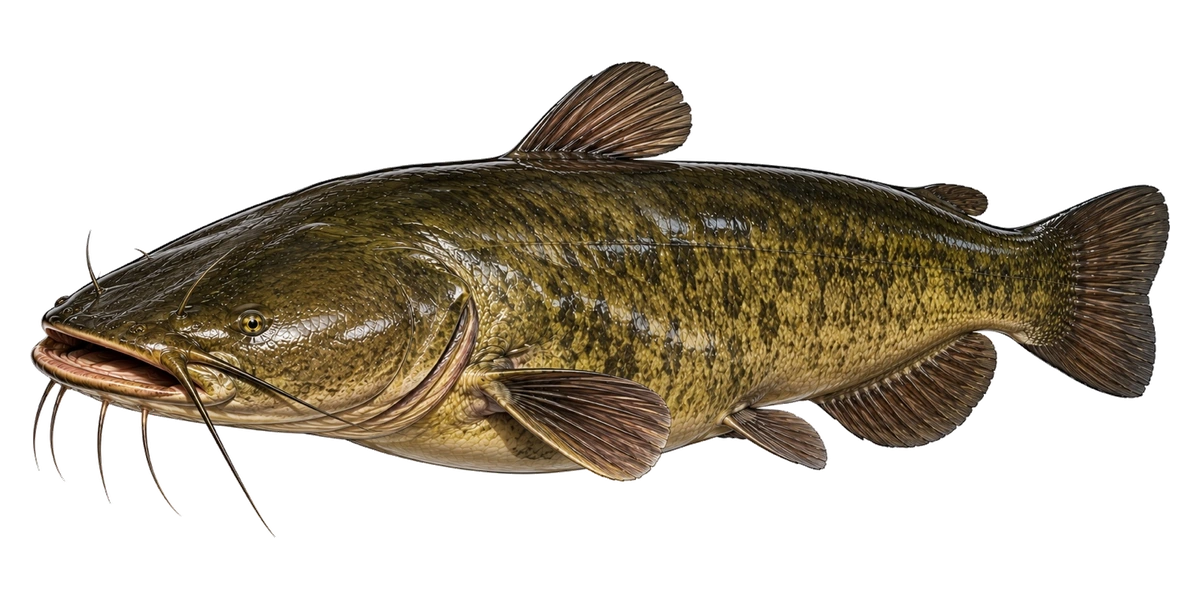
Flathead Catfish
Pylodictis olivarisIctaluridae · Large structure-oriented sport predator
Flathead catfish are heavy-cover predators built around wood, deep holes, undercut banks and protected structure. Adults are strongly fish-oriented, often become more active as light fades, and can leave daytime refuge areas to feed along nearby travel routes. They are usually solitary, but that does not mean they are immobile.
Flathead Catfish Records
Official state records and IGFA current All-Tackle world records. These are not necessarily Lake Fork catches.
Start with the clues that concentrate fish
Look here
Think in pairs: daytime refuge plus nearby feeding access. A deep hole or logjam can be important, but the route from that cover toward prey can become just as important after dark.
Follow the food
Large flatheads are strongly piscivorous, but local evidence matters. Do not turn the old 'fish only' rule into a universal law for every population.
How to fish for them
Use controlled presentations that keep legal live or very fresh natural bait close enough to structure to reach fish without constantly burying the rig in the cover.
Expand outward from the daytime refuge toward nearby feeding water, channel edges and likely travel routes.
Give productive holes, logjams and root-wads repeated attention because flatheads can reuse core areas over time.
Search the surrounding home range and connecting cover before assuming the fish are gone from the system.
Logjams, fallen timber, root-wads and hollow logs provide classic refuge and ambush habitat.
A deep refuge becomes more valuable when it connects quickly to shallower or more open feeding water.
Flatheads often become more active as light fades and may move away from daytime cover to feed.
Compared with Blue Catfish, flatheads generally deserve more attention in slower water and protected current-break habitat.
Solitary does not mean random. Flatheads can show strong attachment to productive cover while still making occasional longer movements.
A few facts that help on the water
The refuge and the feeding area may be different places
Flatheads often hold around heavy cover during the day and become more active as light declines.
They are site-oriented, not permanently parked
Flatheads commonly reuse productive cover and core areas, but they can still make meaningful movements within a river or reservoir.
Find the refuge. Then find the feeding route.
Flatheads are cover-oriented predators. Heavy wood, deep holes and undercuts tell you where they may rest; nearby channels, flats and prey tell you where they may move when it is time to feed.