
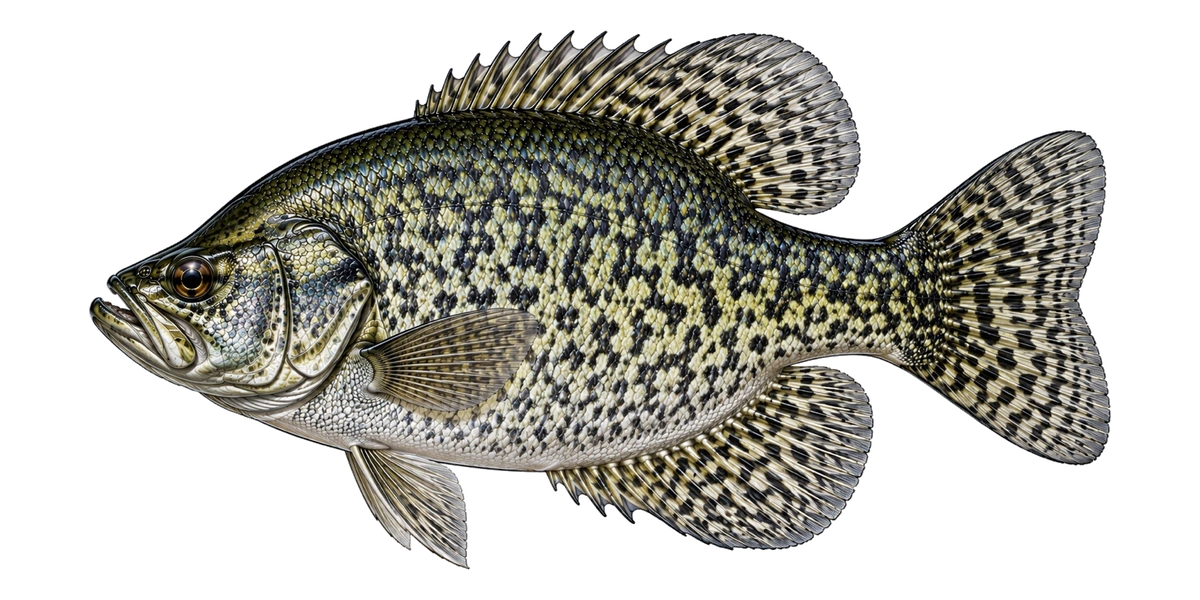
Black Crappie Fishing at O.H. Ivie Reservoir
Pomoxis nigromaculatusCentrarchidae · Schooling/aggregating panfish and small-fish predator
Black crappie are visual predators that often concentrate around submerged cover, vegetation edges and suspended forage. They are closely related to white crappie but are generally less tolerant of turbid, silted water and are often associated with clearer water and vegetation.
Start with the clues that concentrate fish
Look here
Crappie can stack tightly around one piece of cover or suspend beside it. Find the exact depth and position of the fish instead of assuming every brush pile or dock is equally productive.
Follow the food
Young black crappie eat more zooplankton and invertebrates. Small fish become increasingly important as they grow, so adult location often follows small forage.
How to fish for them
Use small jigs, small minnows where legal, or other compact presentations that can be placed precisely beside cover.
Use vertical presentations and control depth carefully so the bait stays in the same level as the fish.
Slow trolling or moving small minnow-profile lures can help locate scattered or suspended crappie.
Match small local forage rather than assuming crappie must always be tight to wood or vegetation.
One brush pile, standing tree, dock or vegetation edge can hold a dense local group while similar nearby cover holds very little.
Crappie frequently hold above, beside or away from cover. Electronics can reveal the actual level fish are using.
Compared with white crappie, black crappie are generally less tolerant of turbidity and siltation and often use clearer, vegetated habitat.
Protected shallow areas with suitable substrate become important as males build and guard nests.
A productive piece of cover can temporarily thin out after repeated catches or heavy angling pressure.
Fast facts worth remembering
- Easy ID clue
- Irregular black speckles and blotches
- Typical dorsal spines
- Usually 7–8
- Family
- Centrarchidae — the sunfish family
- Habitat difference
- Less tolerant of turbidity than white crappie
- Adult food
- Small fish become increasingly important
- Parental care
- Male builds and guards the nest
Facts that change how you think on the water
Cover can hold a local crowd
Adult crappie commonly gather around brush, timber, piers and similar structure, but these groups can be loose aggregations rather than one tightly coordinated school.
They do not have to stay on the cover
Black crappie can use open water adjacent to forage and may suspend above or beside submerged structure.
The diet shifts as they grow
Young black crappie begin with zooplankton and small invertebrates, while fish become increasingly important prey as crappie grow.
Black and white crappie use water differently
Black crappie are generally less tolerant of muddy, silted conditions than white crappie and are often associated with clearer water, vegetation and submerged cover.
A seasonal behavior, not a magic temperature
Black crappie spawn in spring. Males build shallow nests in protected areas and guard the eggs and newly hatched young.
Fishing use: As spring progresses, protected coves and suitable shallow nesting habitat become more important, but not every shallow bank provides the same substrate, protection or nearby depth.
Keep in mind: Spawning temperature varies by region and local conditions. Do not treat one temperature as a universal feeding switch.
Three facts that stick
Spawning males can become darker. Irregular speckles and the usual 7–8 dorsal spines are stronger identification clues.
Male black crappie build the nest and guard the eggs and newly hatched young.
Adults packed around one piece of cover may simply be many fish using the same profitable habitat rather than one coordinated school.
Find the group. Then fish the exact level.
Black crappie can be extremely concentrated, but the useful target is not simply 'brush.' Find the cover or forage, then determine where the fish are actually positioned around it.