
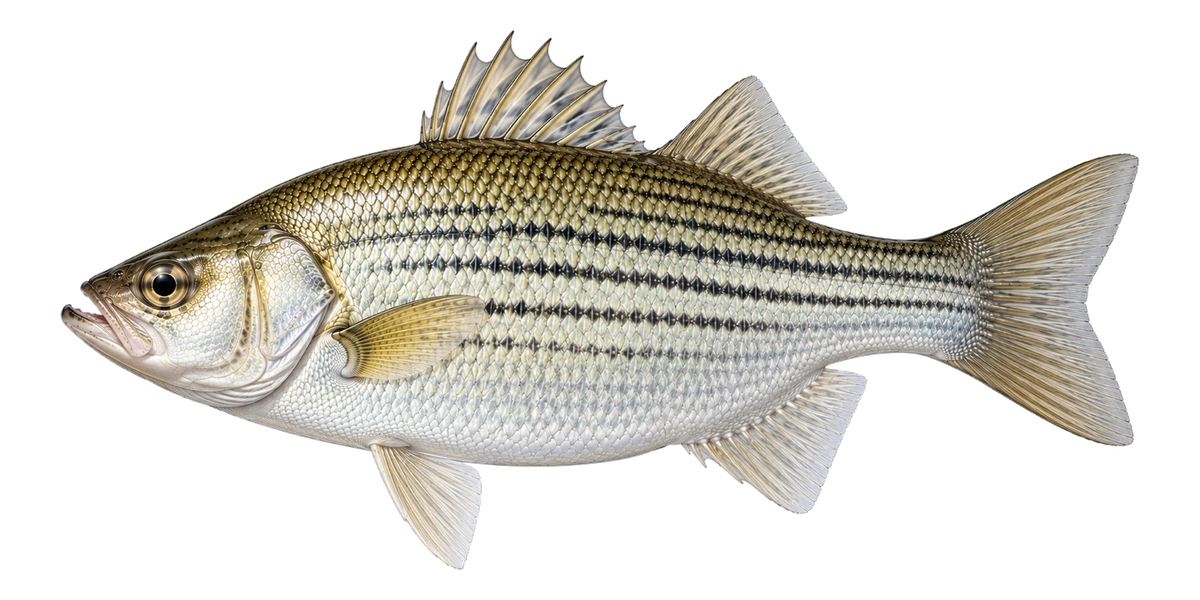
Hybrid Striped Bass / Palmetto Bass Fishing at Lake Norman
Morone saxatilis × Morone chrysopsMoronidae · Stocked open-water sport predator
Hybrid Striped Bass are fast, schooling open-water predators created by crossing Striped Bass and White Bass. They track shad, herring and other pelagic forage, and they can shift quickly between surface feeding, suspended schools and deeper open water as conditions change.
Start with the clues that concentrate fish
Look here
Start with habitat that combines dense shad or herring schools, surface feeding, and open-water sonar marks. Exact depth and location remain waterbody-specific.
Follow the food
Mobile schooling predator that tracks pelagic forage. Match the food actually present in the waterbody and season you are fishing.
How to fish for them
Baitfish-profile casting lures.
Jigs and spoons for vertical schools.
Trolling through forage-rich water.
Live or natural forage presentations where legal.
Concentrated food can pull Hybrid Striped Bass / Palmetto Bass into a much smaller part of otherwise similar water.
Surface feeding becomes more useful when it overlaps with food, season, and usable habitat.
Open-water sonar marks becomes more useful when it overlaps with food, season, and usable habitat.
Spring upstream movement becomes more useful when it overlaps with food, season, and usable habitat.
Usable habitat depends on the combination of temperature, oxygen, season, and food rather than temperature alone.
Fast facts worth remembering
- Scientific name
- Morone saxatilis × Morone chrysops
- Family
- Moronidae
- Feeding style
- mobile schooling predator that tracks pelagic forage
- Parent cross
- Striped Bass × White Bass
- Palmetto cross
- ♀ Striper × ♂ White Bass
Facts that change how you think on the water
Two parent species create one open-water predator
Hybrid Striped Bass combine Striped Bass and White Bass ancestry. The familiar Palmetto cross uses a female Striped Bass and male White Bass, while the reciprocal cross is often called a sunshine bass.
Many fisheries are built through stocking
Hybrid Striped Bass became popular because they perform well in reservoir fisheries and can be produced reliably in hatcheries. Many populations therefore depend heavily on management and stocking rather than natural recruitment.
A hybrid is not automatically sterile
Hybrid Striped Bass are often described as sterile, but natural reproduction has been documented and complete sterility should not be assumed.
They join the spring run
Hybrid Striped Bass can move upstream with Striped Bass and White Bass during spring and may show spawning behavior in flowing-water corridors.
A seasonal behavior, not a magic temperature
Hybrid Striped Bass often make spring upstream movements with Striped Bass and White Bass and can show spawning behavior in flowing-water corridors. Successful natural recruitment is inconsistent, so many fisheries remain stocking-supported.
Fishing use: Use spring river-arm and upstream movement as a seasonal clue without assuming the population is naturally reproducing.
Keep in mind: Spring movement is real, but successful natural recruitment varies by waterbody.
Three facts that stick
The original striped-bass × white-bass hatchery cross was produced in South Carolina in 1965.
Female striped bass × male white bass is the Palmetto cross; the reciprocal cross is commonly called sunshine bass.
Natural reproduction has been reported, although successful recruitment is inconsistent and lake-specific.
Find bait. Then stay with the school.
Hybrid Striped Bass are built to move. Surface activity, sonar and forage position can change faster than a fixed structure pattern, so keep following the bait instead of fishing yesterday's waypoint.