
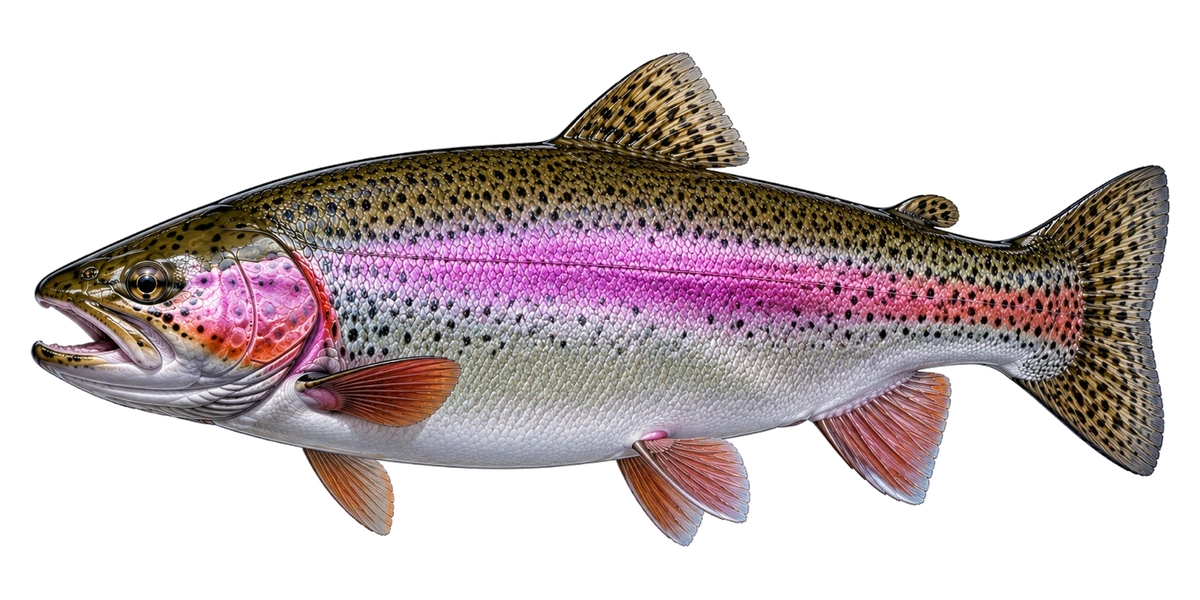
Rainbow Trout Fishing at Lake Jocassee
Oncorhynchus mykissSalmonidae · Coldwater sport fish
Rainbow Trout are coldwater sport fish that need cool, oxygenated water and can feed on everything from tiny aquatic insects to larger forage fish as they grow. In streams, current and insect life matter; in reservoirs, usable temperature, oxygen and prey can push larger trout into very different water.
Start with the clues that concentrate fish
Look here
Start with habitat that combines cold water, adequate dissolved oxygen, and insect activity in streams. Exact depth and location remain waterbody-specific.
Follow the food
Opportunistic coldwater predator that shifts from invertebrates toward larger prey as size and habitat permit. Match the food actually present in the waterbody and season you are fishing.
How to fish for them
Use small flies, nymphs and other insect imitations where trout are feeding on aquatic or terrestrial insects.
Spoons and spinners can imitate small prey while covering water in streams, rivers and lakes.
Use forage-fish imitations when bigger Rainbow Trout are clearly feeding on fish rather than insects.
Trolling or controlled-depth presentations can reach trout holding in cool, oxygenated layers away from the bank.
Cold water becomes more useful when it overlaps with food, season, and usable habitat.
Usable habitat depends on the combination of temperature, oxygen, season, and food rather than temperature alone.
Insect activity in streams becomes more useful when it overlaps with food, season, and usable habitat.
Concentrated food can pull Rainbow Trout into a much smaller part of otherwise similar water.
Moving water can concentrate food and create travel lanes or current breaks during seasonal transitions.
Fast facts worth remembering
- Scientific name
- Oncorhynchus mykiss
- Family
- Salmonidae
- Feeding style
- opportunistic coldwater predator that shifts from invertebrates toward larger prey as size and habitat permit
- Life-history form
- Steelhead are sea-run Rainbow Trout
- Water need
- Cold, well-oxygenated habitat
Facts that change how you think on the water
Cold water is not enough by itself
Rainbow Trout need cold water with enough dissolved oxygen to support them. In deep lakes and reservoirs, the best-looking depth can become unusable if oxygen is poor.
A steelhead is still a Rainbow Trout
Steelhead are the anadromous life-history form of Oncorhynchus mykiss: the fish migrates to salt water and later returns to freshwater to spawn. South Carolina reservoir and mountain-stream fish do not become a different species simply because they never reach the ocean.
Females build gravel redds
Rainbow Trout spawn over clean gravel where females excavate shallow redds and cover fertilized eggs. Flow, clean substrate and cold oxygenated water all influence successful natural reproduction.
Young and old trout do not eat the same way
Young Rainbow Trout can feed heavily on zooplankton and small invertebrates, while adults add aquatic and terrestrial insects, crustaceans, eggs and small fish as size and habitat allow.
A seasonal behavior, not a magic temperature
Rainbow Trout spawn in cold freshwater over clean gravel, with timing varying widely by latitude and population. Females build redds, deposit eggs and cover them; there is no extended parental guarding after the eggs are buried.
Fishing use: During spawning periods, clean gravel and tributary or stream movement can become important, but exact timing must come from the local fishery.
Keep in mind: Do not use one universal summer depth for rainbow trout; temperature and oxygen profiles differ by lake.
Three facts that stick
The difference is life history, not species identity.
Some Rainbow Trout remain in freshwater for life, while steelhead migrate to the ocean and return to freshwater to spawn.
Habitat, prey and growth opportunity create enormous size differences.
Find cold, oxygenated water—then find food inside it.
Temperature tells only half the story. Rainbow Trout still need oxygen and prey, so the useful depth is where all three overlap.