
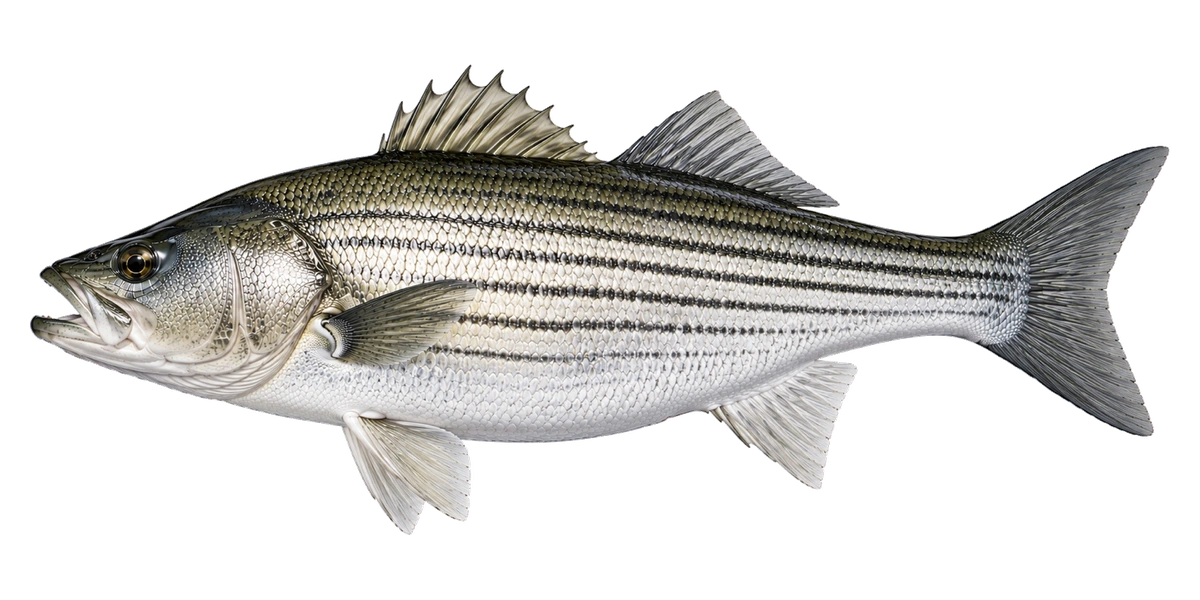
Striped Bass Fishing at Lake Greenwood
Morone saxatilisMoronidae · Large schooling reservoir predator
The striped bass in a landlocked lake is the same species as the striped bass that swims the Atlantic coast: Morone saxatilis. In reservoirs, though, the fishing game is different. Lake stripers are mobile open-water predators that follow forage while constantly balancing season, current, temperature and dissolved oxygen.
Start with the clues that concentrate fish
Look here
Do not treat striped bass like a fish that permanently lives on one piece of structure. They are mobile predators. The better question is where forage and usable water overlap right now.
Follow the food
The most useful bait question is not simply what stripers eat. It is what the striped bass in this reservoir are feeding on now. Match the dominant forage in that lake.
How to fish for them
Free-line, down-line or vertically present legal natural forage at the depth where fish and bait are showing.
Use vertical jigs or other presentations that can stay in the same depth band as suspended fish.
Troll through forage-rich water to cover ground and locate moving schools.
Cast baitfish-profile lures to actively feeding schools and keep moving with the fish instead of anchoring to yesterday's spot.
Striped bass are strongly forage-oriented. Concentrated bait is one of the best reasons for a school of stripers to occupy a piece of open water.
Stripers often hold in the water column rather than on the bottom. Sonar depth matters because your presentation needs to intersect the fish.
In warm stratified reservoirs, cool deep water may not have enough dissolved oxygen. Summer fish can be compressed into the limited layer where both conditions are usable.
Landlocked stripers can redistribute dramatically through a reservoir as spawning behavior, water quality and forage change.
River arms, channel corridors and moving water can become important during seasonal transitions, especially around spring movement.
Fast facts worth remembering
- Same fish as the ocean
- Lake and Atlantic striped bass are both Morone saxatilis
- Family
- Moronidae — the temperate bass family
- Body pattern
- Usually 7–8 dark horizontal stripes
- Feeding style
- Mobile schooling predator that follows forage
- Summer limiter
- Usable habitat depends on both temperature and oxygen
- Reservoir management
- Many inland fisheries are maintained through stocking
Facts that change how you think on the water
The bait can matter more than the structure
Striped bass are mobile predators that commonly follow concentrated forage through open water instead of remaining tied to one piece of cover.
Summer can squeeze them into a narrow band
In stratified reservoirs, surface water can become too warm while deeper water loses dissolved oxygen. Adult landlocked striped bass may be forced into a smaller zone where temperature and oxygen overlap.
Reservoir stripers are built to move
Striped bass can make substantial seasonal movements within large reservoirs as water conditions, forage and reproductive behavior change.
Spring movement does not guarantee a self-sustaining population
Striped bass spawn in flowing freshwater and their semi-buoyant eggs need enough current and river distance to remain suspended while developing. Many reservoirs do not provide enough suitable spawning habitat and are therefore supported by stocking.
A seasonal behavior, not a magic temperature
Striped bass spawn in spring in flowing freshwater. They do not build nests; eggs are released into current and remain suspended while developing.
Fishing use: During the spring transition, give river arms, channel corridors and upstream movement routes extra attention as fish respond to reproductive behavior.
Keep in mind: Seeing fish move upstream does not mean that reservoir has enough flowing habitat for successful natural reproduction.
Three facts that stick
A landlocked reservoir striper and an Atlantic coastal striper are the same species. The environment changes the lifestyle, not the identity of the fish.
Striped-bass eggs are semi-buoyant and successful development depends on enough flowing water to keep them suspended.
In summer, the deepest water may be cool but too low in dissolved oxygen. The usable layer has to satisfy both needs.
Find bait. Then find usable water.
Landlocked stripers are open-water hunters. Follow the forage, but always ask whether the water around that forage is actually usable for the fish—especially in summer when temperature and dissolved oxygen can squeeze their habitat.