
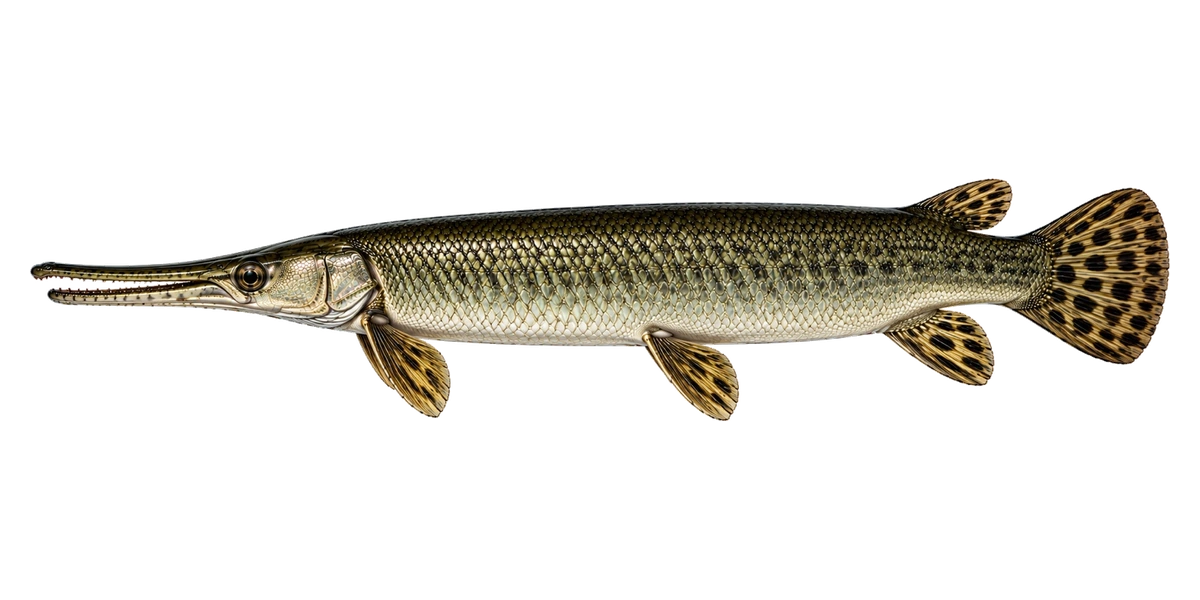
Longnose Gar Fishing at Lake Greenwood
Lepisosteus osseusLepisosteidae · Native large-river and reservoir ambush predator
Longnose Gar are long, armored ambush predators of rivers and reservoirs. They often cruise or hold near forage, then use a sudden sideways lunge to seize fish. Because they can gulp air, repeated surface rolls may reveal their location even when they are not actively feeding.
Start with the clues that concentrate fish
Look here
Start with habitat that combines surface rolling or air gulping, schools/concentrations of forage, and deep slow pools and reservoir basins. Exact depth and location remain waterbody-specific.
Follow the food
Stealth-stalking piscivore that lunges sideways to seize prey and can gulp air with a vascularized swim bladder. Match the food actually present in the waterbody and season you are fishing.
How to fish for them
Surface rolling, cruising fish and shallow sightings can reveal where Longnose Gar are using the water column.
Natural baitfish and prey-shaped moving presentations fit a predator that feeds primarily on fish where legal.
Gar often stalk before lunging, so a controlled prey-like movement can make more sense than nonstop high-speed retrieves.
Their hard jaws, sharp teeth and armored body call for sturdy tackle, long-handled tools and careful handling.
Surface rolling or air gulping becomes more useful when it overlaps with food, season, and usable habitat.
Concentrated food can pull Longnose Gar into a much smaller part of otherwise similar water.
Deep slow pools and reservoir basins becomes more useful when it overlaps with food, season, and usable habitat.
Shallow spring spawning activity becomes more useful when it overlaps with food, season, and usable habitat.
Fast facts worth remembering
- Scientific name
- Lepisosteus osseus
- Family
- Lepisosteidae
- Feeding style
- stealth-stalking piscivore that lunges sideways to seize prey and can gulp air with a vascularized swim bladder
- Egg potential
- up to ~77,000
Facts that change how you think on the water
The snout is the giveaway
Longnose Gar have extremely long, narrow jaws—more than twice the length of the rest of the head—with a particularly narrow snout near the nostrils.
Armor made of ganoid scales
Gar bodies are covered with hard, diamond-shaped ganoid scales, very different from the flexible scales of most common sport fish.
A swim bladder that works like a lung
Longnose Gar can use a vascularized swim bladder for aerial respiration when dissolved oxygen is low.
They stalk instead of chasing
Longnose Gar can advance with very little visible motion, lunge sideways to seize prey, then turn the fish headfirst to swallow it.
A seasonal behavior, not a magic temperature
Longnose Gar spawn during spring in shallow water, often with several males accompanying a larger female. Eggs are scattered and attach to vegetation or other substrate rather than being guarded in a nest.
Fishing use: Shallow spring commotion can be reproductive behavior rather than active feeding.
Keep in mind: Gar roe is toxic to humans and other warm-blooded animals; never treat the eggs as food.
Three facts that stick
Gar roe is toxic to humans and other warm-blooded animals.
Hatchlings use a temporary adhesive snout structure.
The swim bladder functions as an accessory respiratory organ.
A surface roll tells you where. Forage tells you why.
Longnose Gar may surface simply to gulp air, so do not confuse every roll with feeding. Once you locate them, look for the baitfish and travel lanes that explain why they are using that area.