
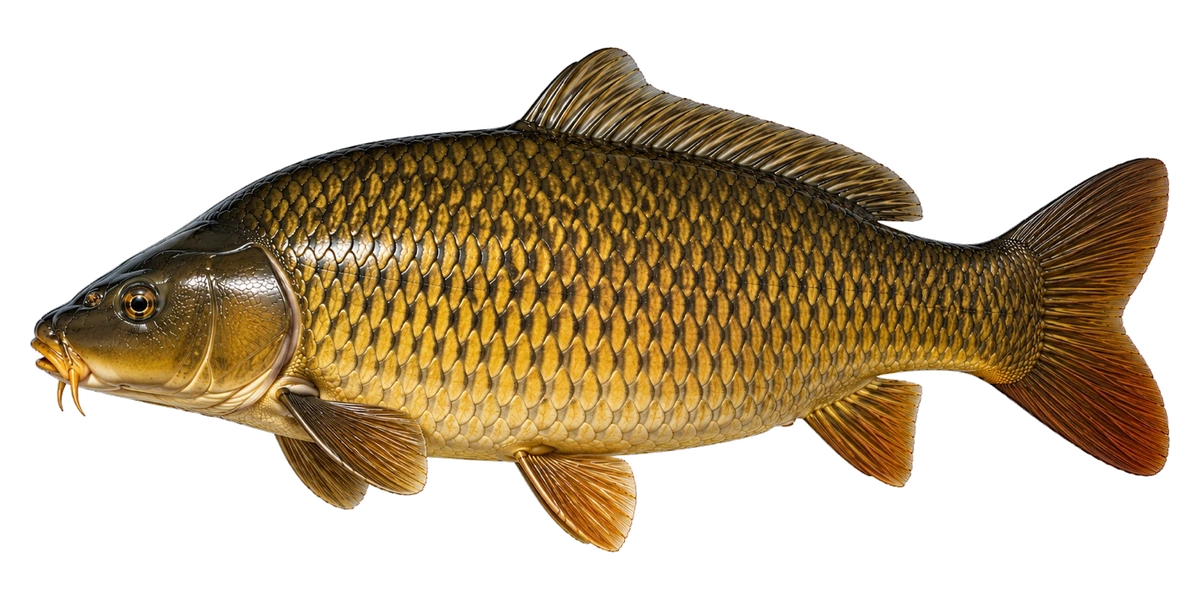
Common Carp Fishing at Lake Greenwood
Cyprinus carpioCyprinidae · Large nonnative benthic omnivore and sport fish
Common Carp are large benthic omnivores that often reveal themselves while feeding. Tailing fish, bubbles, mud puffs and shallow rooting can show where carp are vacuuming worms, insect larvae, crustaceans, mollusks and plant material from soft bottom. Quiet presentation and accurate placement matter more than flashy movement.
Start with the clues that concentrate fish
Look here
Start with habitat that combines visible tailing or mud puffs from bottom feeding, shallow vegetation during spring warming, and soft-bottom flats rich in invertebrates. Exact depth and location remain waterbody-specific.
Follow the food
Powerful benthic omnivore that vacuums soft substrate, sorts edible material and can also feed higher in the water column. Match the food actually present in the waterbody and season you are fishing.
How to fish for them
Present natural or prepared baits where feeding carp are already searching, especially along soft-bottom feeding lanes.
Cast quietly ahead of tailing or mudding fish instead of dropping a bait directly on top of them.
Use small food items that resemble what carp are actually finding in that water rather than relying on one universal bait.
Use surface presentations only when carp are clearly feeding there; bottom feeding is far more common.
Visible tailing or mud puffs from bottom feeding becomes more useful when it overlaps with food, season, and usable habitat.
Cover and edges can create feeding or refuge advantages, especially where they meet food or a depth change.
Soft-bottom flats rich in invertebrates becomes more useful when it overlaps with food, season, and usable habitat.
Surface cruising or feeding fish becomes more useful when it overlaps with food, season, and usable habitat.
Cover and edges can create feeding or refuge advantages, especially where they meet food or a depth change.
Fast facts worth remembering
- Scientific name
- Cyprinus carpio
- Family
- Cyprinidae
- Feeding style
- powerful benthic omnivore that vacuums soft substrate, sorts edible material and can also feed higher in the water column
- Origin
- Eurasia; introduced widely in North America
- Feeding zone
- Primarily soft bottom and benthic food
Facts that change how you think on the water
Common Carp are introduced in North America
Common Carp are native to Eurasia and were introduced widely across North America. Long-established populations can now be part of many familiar lake and river fisheries.
A mouth built to vacuum the bottom
Common Carp feed by sucking soft sediment into the mouth, separating edible worms, insect larvae, crustaceans, mollusks and plant material, then expelling unwanted material. Rooting can resuspend fine sediment.
Those barbels are sensory tools
Common Carp carry two pairs of barbels around the upper jaw. Along with taste receptors around the mouth, they help a fish locate food in turbid water or soft substrate where vision alone would be inefficient.
Spawning can sound like something fell in the lake
During warm-season spawning, several carp may crowd shallow vegetated water and splash vigorously while adhesive eggs are released.
A seasonal behavior, not a magic temperature
Common Carp usually spawn during the warm spring-to-early-summer period, gathering in shallow vegetated water where adhesive eggs are scattered. Exact timing varies with latitude and local warming.
Fishing use: Shallow splashing and commotion may be reproductive behavior rather than feeding, so verify whether fish are actually eating before choosing a presentation.
Keep in mind: Spawning temperature is not a universal feeding-temperature rule.
Three facts that stick
Common Carp are Eurasian fish that became established across much of North America after deliberate and accidental introductions.
Rooting carp can resuspend fine sediment while sorting food from mud and silt.
Groups of carp can create loud splashing and visible commotion while spawning in shallow vegetation.
Read the mud.
Tailing, bubbles, mud puffs and slow cruising can show you exactly where carp are feeding. Put the bait on the feeding path quietly instead of casting at random water.