
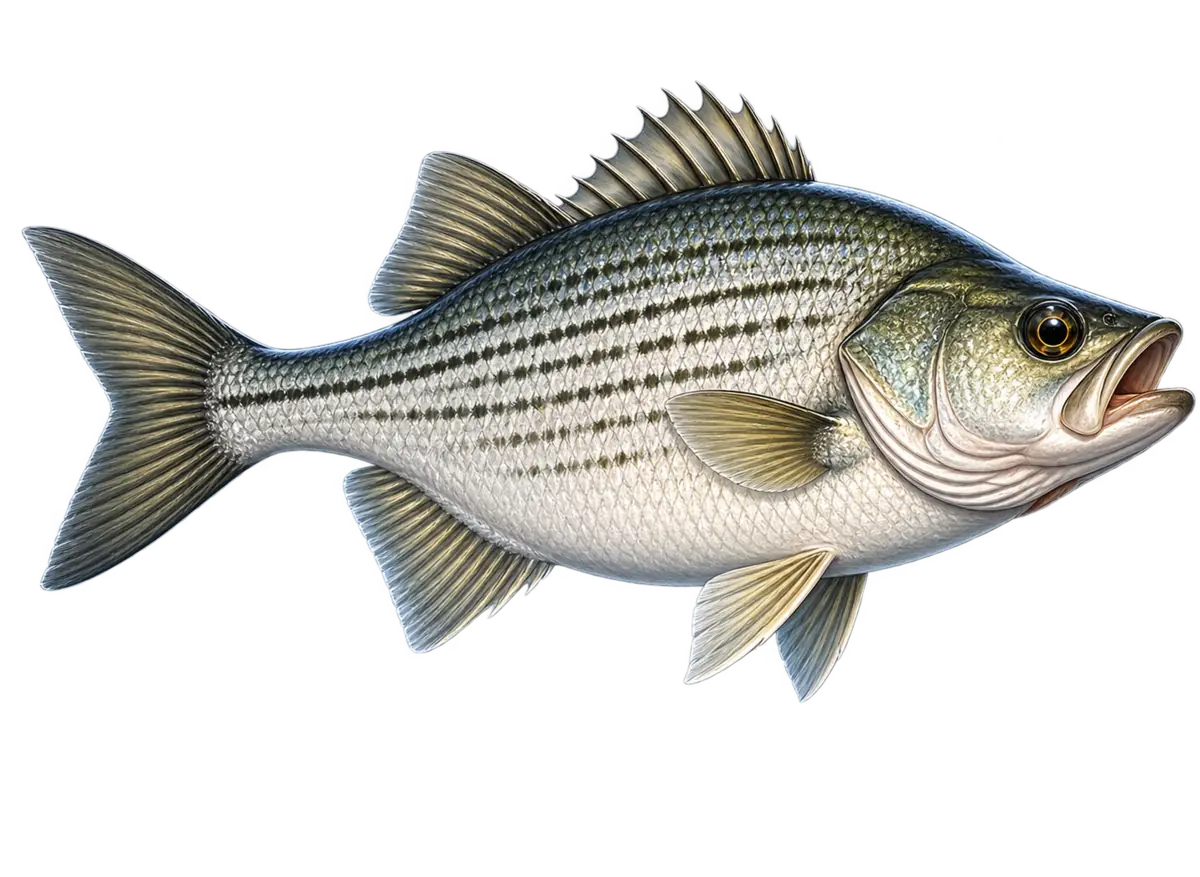
White Bass Fishing at B. Everett Jordan Lake
Morone chrysopsMoronidae · Schooling open-water sport predator
White bass are compact, fast-moving freshwater predators built around schools and baitfish. Much of the year they roam open water, but spring can dramatically change the map as adults move toward tributaries, reservoir headwaters and rocky shoals to spawn.
Start with the clues that concentrate fish
Look here
White bass are a moving-school problem more than a permanent-spot problem. Structure helps narrow the search, but forage and the school itself usually matter more.
Follow the food
Adult White Bass are strongly fish-oriented. Match the lake's actual forage rather than assuming every population eats the same baitfish.
How to fish for them
Move quickly and cast compact baitfish imitations to active fish without driving directly through the school.
Use sonar and present small jigs or spoons at the depth of the fish rather than assuming they must be on bottom.
Cover forage-rich open water and channel routes when schools are scattered or difficult to hold over.
Shift attention toward tributaries, headwaters and rocky shoals as the freshwater spawning migration develops.
White Bass often make the forage school itself the most important piece of structure.
Visible feeding can reveal a school, but a quiet surface does not mean the fish left the area.
Schools can remain deep and far from shore with no visible surface clue.
Tributaries, headwaters and shoals gain importance during the spawning migration, then lose that special role afterward.
Dawn and dusk can be active feeding windows, but confirmed fish and forage should outrank the clock.
Fast facts worth remembering
- Scientific identity
- Morone chrysops
- Family
- Moronidae — temperate basses
- Behavior
- Strongly schooling open-water predator
- Adult diet
- Primarily small fish
- Migration
- Spring spawning movement occurs entirely in freshwater
- Identification clue
- Single tooth patch on the tongue
Facts that change how you think on the water
The school is the target
White Bass are mobile schooling predators that follow concentrated forage in open water.
Spring rewrites the map
Adults move toward tributaries, headwaters and rocky shoals during their freshwater spawning migration.
Their diet changes as they grow
Young White Bass use small invertebrates while fish become increasingly important as they mature.
Mixed Morone fisheries demand careful ID
White Bass, Striped Bass and their hybrids can overlap and popular shortcuts such as broken stripes are not reliable by themselves.
A seasonal behavior, not a magic temperature
White Bass make a spring freshwater migration toward tributaries, reservoir headwaters and rocky or gravel shoals, where groups broadcast eggs and milt without building or guarding nests.
Fishing use: Treat the spawning run as a temporary concentration event: find the migration corridor while it is active, then expect adults to redistribute toward open-water feeding habitat.
Keep in mind: Spawning temperature is a reproductive cue, not a universal feeding temperature or permanent location rule.
Three facts that stick
White Bass can make substantial spawning migrations entirely within freshwater.
White Bass are one parent of hybrid striped bass.
A school may stop feeding visibly at the surface while remaining concentrated deeper in the same general open-water system.
Find the bait. Find the school. Keep moving.
White Bass are mobile open-water predators. The best waypoint is often the forage school, not a stump or dock. In spring, let the spawning migration temporarily change the search toward upstream corridors.